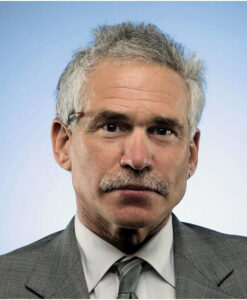
Accountability is Focus of L.A. Times
Washington Bureau

By Bob Rawitch

Accountability reporting is still the focus of an L.A. Times Washington, D.C. bureau that may be smaller than in the paper’s glory years but no less ambitious, the bureau chief and top political editor told the OFS in a May 27 Zoom call.

Michael Wilner, bureau chief, and Steve Clow, assistant managing editor for national politics, discussed how the six-person bureau operates in an environment of far fewer resources.

“We look to do enterprise reporting that moves a story forward,” said Wilner, who started his career at the Jerusalem Post and then spent seven years in McClatchey’s Washington Bureau before joining The Times as D.C. Bureau Chief in February 2025.

As opposed to a peak of an estimated 60 staffers more than 25 years ago, with an investigative team and staffers in most major federal agencies, the current bureau is clearly not able to staff every major beat and doesn’t try to.

David Savage has long covered the U.S. Supreme Court, and Ana Castillo reports on immigration. Wilner recently hired Ana Ceballos from the Miami Herald to cover the White House and Congress, and Ben Weider to do investigative projects. Justine McDaniel came from the Washington Post to cover national politics.

“We’re small, but mighty,” Wilner said, explaining he urges each reporter to be working two enterprise stories on the back burner while attacking the stories of the day.

Clow, a 33-year veteran of the paper, said the Washington team works closely with the Sacramento Bureau when it comes to covering the 52-member California Congressional delegation. The Times intends to focus on the most competitive races in the state after the passage of a redistricting measure that theoretically could give the Democrats up to an additional five seats in the November election.

One seat they clearly will be watching is the new 40th district, where Rep. Young Kim and Rep. Ken Calvert are battling for the Republican nomination for an area that covers parts of Orange, Riverside, and San Bernardino counties.

Wilner said they also will be watching whether youthful challengers prevail against longtime incumbents Reps. Maxine Waters, Brad Sherman, and Nancy Pelosi.

“One priority is trying to look ahead at races that portend to where the two parties are going as we enter a presidential election in two years,” Wilner said, the first without an incumbent president in 12 years.

If the 2026 midterm elections follow precedent and the Democrats take control of the House of Representatives, Wilner expects the Democrats to use their control of the House Oversight Committee to investigate many of Trump’s actions in his first two years in office.

In a wide-open race in 2028 for president for both parties, he said the Democrats will no doubt try to tie many of Trump’s most controversial actions to the eventual Republican presidential nominee. “I’d put my money on that,” he said.

There still is a small physical office that serves as a bureau for the six staffers and others who travel back to D.C, but staffers can also use what he called “legacy” spots in press rooms of the White House, Congress, State Department and Supreme Court.

D.C. staffers are edited by Clow and Steve Padilla, who along with editing the Column One feature is the de facto foreign editor, Clow said.

There are no longer dedicated national bureaus, Clow said, but there are reporters based outside California, like Kevin Rector who splits his time between California and Colorado, Jenny Jarvie who works on the fast break team from Atlanta, and Summer Lin who works on the same team out of New York.

In what some call a post-truth phase of politics, where politicians, led by President Trump, openly misstate information they know is false, both Wilner and Clow said the paper does it best to correct clearly inaccurate information when they can.

“We try not to print things that we know are false,” Clow said, “and we do our best to fact-check.” But he says the day is fast-paced, with current off-the-floor deadlines now 6 p.m. since the paper is printed in Riverside. “We just try to be rigorous and skeptical and careful.”

“Omission is sometimes a very important decision,” Wilner added. “We have lengthy conversations about what we truly know and what we can include on a regular basis.”

Neither man had a comment on The Times for the first time in its history making no endorsements in any of the local or statewide political races because owner Dr. Patrick Soon-Shiong has not rebuilt the editorial board since the entire board left the paper one by one after he squashed its planned endorsement of Kamala Harris for president in 2024.

A video of the Zoom session can be viewed at https://us02web.zoom.us/rec/share/MhGQerky1X6wQkYuFZ7zJgp9RH7E64qa2JmaMsLJli1t328MiKsA26QQwUplQ17P.mlRr5bSK2NXyHdD1?startTime=1779907921000, using the passcode OFSLA0526!